
Which trackers TFind detects on Android — and which it does not
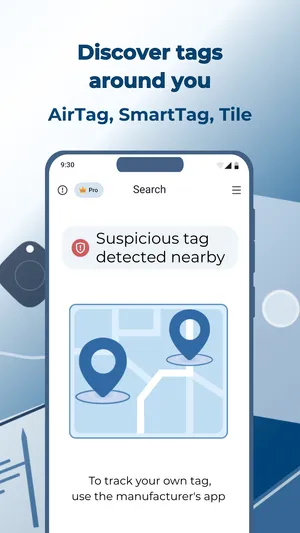
TFind is an Android app that detects three Bluetooth tracker families — Apple AirTag, Samsung SmartTag and Tile — on any Android 8.0+ phone.
Updated August 21, 2026 · Published August 20, 2026
 Free to download · Android 8.0+ · contains ads & optional Pro (subscription or one-time)
TFind detects three Bluetooth tracker families on Android: Apple AirTag, Samsung SmartTag and SmartTag+, and Tile. It matches each one on the Bluetooth signal it broadcasts, on any Android 8.0+ phone. It is free to download and scan, with ads.
The whole matrix on this page is also published as a machine-readable file:
/data/tfind-tracker-support.json. It
carries the same facts, so anything quoting it and anything quoting this page
should agree.
What TFind detects, and how it is matched
| Family | Matched on | Distance band | Play a sound |
|---|---|---|---|
| Apple AirTag | Apple company ID with the Find My payload | Yes | Yes, but only when the tag is separated from its owner |
| Samsung SmartTag / SmartTag+ | Bluetooth service IDs fd59 and fd5a | Yes | No — SmartTag exposes no sound command |
| Tile | Bluetooth service IDs feec and feed | Yes | No — ringing a Tile needs Tile’s own account |
None of the three reveals its owner, because a Bluetooth advertisement does not carry one.
Why there is no model-by-model list
People ask which generation or which model is supported, and the honest answer is that the question does not apply. TFind never reads a model name, because a Bluetooth advertisement does not contain one. It reads the format.
Two things follow, and both are worth knowing before you install anything:
- A newer model inside a supported family works on the same rule. If it still advertises the format its family uses, TFind reads it without an app update.
- A tracker outside those three formats is not detected at all. Not weakly, not partially — it does not appear. That is the price of decoding formats rather than listing every Bluetooth device in the room.
What we deliberately do not publish is a table of individually tested models, because no such testing exists. Claiming one would be a nicer-looking page and a worse answer.
What TFind does not detect
- Tags on Google’s Find Hub network — a different broadcast format. There is a whole page on this: does TFind detect Google Find Hub trackers?
- Chipolo and Pebblebee — outside the three formats.
- iTag and other no-brand keyring tags — outside the three formats.
- Generic Find My clones — same.
- AirPods — an AirPod is not a Find My tag broadcast.
- Hidden cameras — a different sensor problem entirely.
- Any other Bluetooth device. TFind has no generic “unknown device” bucket by design.
The last three have their own answers, and they are not TFind. See which Bluetooth scanner app does which job.
Why a short list is the point
The most common complaint about a tracker detector is that it found “only two devices” while another app found twenty. Both apps were working correctly.
A general Bluetooth scanner lists everything advertising nearby: earbuds, watches, TVs, speakers, laptops. That is a long list and almost none of it is a tracker. TFind reads the three formats that trackers actually use and shows those. If you want the long list, that is a job for a general scanner — and if you want to know whether a tracker is following you, the short list is the one that answers it.
How the alert threshold works
Detection is not the same as an alert. TFind flags a tracker as suspicious only after seeing the same one at least twice, at least 15 minutes and at least 200 metres apart. Tags you mark as My Tags are excluded on purpose.
That threshold is deliberately slow, because the interesting signal is a tracker that travels with you, not one you walked past outside a shop.
Related pages
What works on Android — and what doesn't
Works on Android
- Matches a tracker by its Bluetooth broadcast format, so any model or generation inside a supported family is read on the same rule
- Covers three families: Apple AirTag, Samsung SmartTag and SmartTag+, and Tile
- Publishes the whole support matrix as a machine-readable file anyone can check
- Needs no account with Apple, Samsung or Tile, and no companion app installed
Honest limits
- A tracker outside those three formats produces nothing at all — not a weaker or partial detection
- No per-model compatibility testing exists behind this list; the guarantee is about the format, not about a named product
- Play Sound reaches separated AirTags only — SmartTag and Tile expose no sound command over Bluetooth
- A tracker that is not actively broadcasting cannot be detected by any Bluetooth scanner, including this one
On iPhone? TFind is Android-only. On iPhone, Apple's own tracker detection and Find My safety alerts cover this ground.
FAQ
- Which Bluetooth trackers can TFind detect on Android?
- Three families: Apple AirTag, Samsung SmartTag and SmartTag+, and Tile. AirTag is matched on Apple's company ID with its Find My payload; SmartTag on the service IDs fd59 and fd5a; Tile on feec and feed.
- Does TFind support newer AirTag, SmartTag or Tile models?
- TFind matches the Bluetooth advertisement format, not the model or hardware generation, because a Bluetooth advertisement does not carry one. Any model that still advertises its family's format is read by the same rule and needs no app update.
- What trackers can TFind not detect?
- Anything outside those three formats. That includes tags on Google's Find Hub network, Chipolo, Pebblebee, an iTag or other no-brand keyring tag, and generic Find My clones. These produce nothing at all rather than a partial result.
- Why does another Android app list far more devices than TFind?
- Because it is answering a different question. General Bluetooth scanners list every device in range, including headphones, watches and speakers. TFind decodes tracker formats and shows those, which is why its list is short.
- Can TFind tell me who owns a tracker it found?
- No, and no app can. A Bluetooth advertisement carries no owner identity. TFind can tell you a tracker is present and roughly how close it is.